
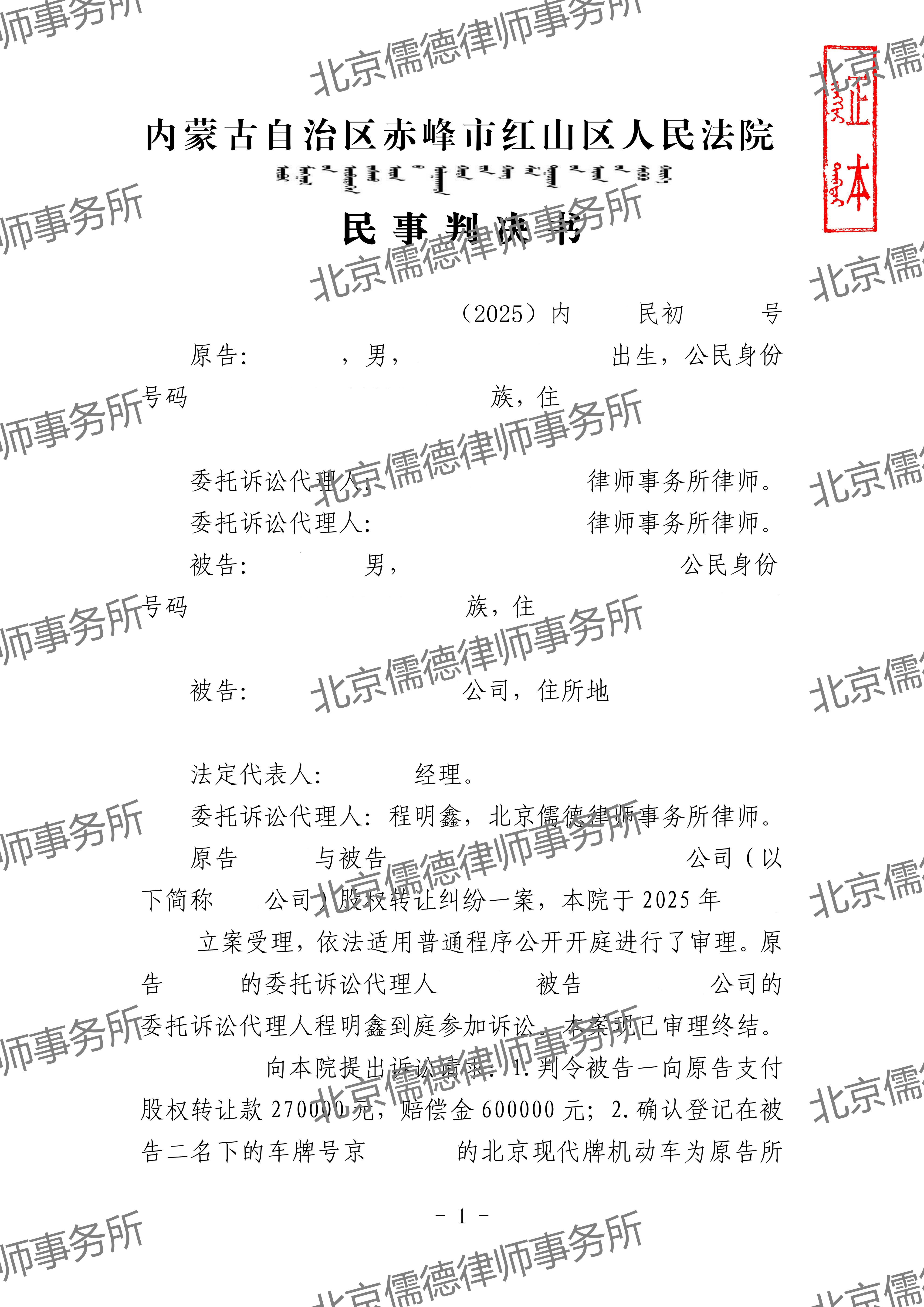
This case is a typical dispute involving the formal transfer of equity shares, while the substance is the illegal sale of a Beijing vehicle license plate quota. Plaintiff A sued for the payment of equity transfer fees, breach of contract damages, and confirmation of vehicle ownership, claiming damages totaling 870,000 RMB. Attorney Cheng Mingxin from Beijing Rudu Law Firm represented Defendant B and Company A. By focusing on the three core points that "vehicle license plate quotas are non-transferable, the contract is invalid, and no liability is assumed," he mounted a precise defense. Ultimately, the court dismissed the vast majority of the plaintiff's claims, ruling only that the parties must cooperate in the transfer of vehicle ownership. This outcome maximized the protection of the client's legitimate rights and interests, making it a landmark victory in such "equity license plate" disputes.
In 2023, Plaintiff A and Defendant B entered into a "Share Transfer Agreement" and a "Supplementary Agreement," stipulating the tran 100% equity in Company A. The substantive consideration was three Beijing small passenger vehicle quotas registered under the company. It was agreed that Plaintiff A could use the quota and vehicle bearing licese plate No. Jing G**7** free of charge for a long term, and Defendant B issued a "Letter of Commitment" promising to pay 600n in damages for breach of contract. Subsequently, disputes arose between the parties, and Plaintiff A was unable to use the vehicle normally. Consequently, Plaintiff A filed a lawsuit against ndants B and Company A, demanding payment of the share transfer consideration, liquidated damages, and confirmation of ownership of the vehicle, with total claims amountig to 870,000 yuan. Both defendants denied the plaintiff's claims. Defendant B argued that the parties were actually trading license plates, rendering the agreement invalid; Company A argued that there was no shrelationship with the plaintiff and thus bore no joint liability.

Attorney Cheng Mingxin has been practicing law since 2018. He has participated in advisory work for the Policy and
Regulations Department of a natioal ministry, mediation work for a grassroots court, and asset disposal work for an
asset management company. He is currently employed at Beijing Rudu Law Firm, specializing in contract disputes,ily
law, and creditor-debtor matters.
Areas of Expertise: Labor disputes, legal counsel, contract disputes, family law, inheritance, debt disputes, real estate
disputes, traffic ac and medical malpractice.
After Party B and Company A became involved in litigation, Party B entrusted Lawyer Cheng Mingxin of Beijing Rudu
Law Firm to represent the case. Upon reviewing the case files, the lawyer quickly identified the key issue: although the
transaction was nominally a share transfer, it was actually an illegal trade of Beijing passenger vehicle quotas, violating
Beijing's vehicle control policies and public order and good morals; therefore, the relevant agreements should be
deemed invalid. Consequently, the legal strategy was formulated as follows:
Assert that the "Supplementary Agreement" and "Letter of Commitment" are invalid due to the disguised sale of
license plates and the harm caused to public interests, and that the 600,000 yuan compensation claim lacks basis;
simultaneously, clarify the parties involved in the share transfer and the legal relationships to prove that Company A is
not a party to the contract and bears no joint liability; regarding the issue of vehicle ownership, respect the facts and
evidence to avoid expanding the dispute, and uphold the core bottom line that the company bears no liability for
monetary payment.
During the trial, Attorney Cheng Mingxin presented a professional defense centered on the key issues:
1. Contract Invalidity: He clarified that the agreement in question used the legal form of equity transfer to mask the
illegal purpose of trading Beijing vehicle license plates, violating the *Interim Provisions on the Regulation of the
Number of Beijing Small Passenger Vehicles. As this disrupted public order, the agreement should be deemed invalid,
rendering the penalty clause naturally invalid.
2. Separation of Liability: He pointed out that the industrial and commercial registration records show the equity
transfer parties to be third-party companies; Party A was not a registered shareholder, and Party B was not the
transferee. Consequently, Party A's claim for 270,000 yuan in equity transfer payment lacks factual and contractual
basis. Company A is merely the entity after a name change and is not the party responsible for the debt; thus, it should
not bear joint liability.
3. Objective Statement of Vehicle Facts: He truthfully described the funding and usage of the vehicle, not denying
the fact of actual possession and use. However, he clarified that the company did not obstruct the transfer of
ownership and therefore should not bear monetary compensation.
Throughout the process, Attorney Cheng Mingxin maintained clear logic and ample evidence. He systematically
dissected the complex issues regarding equity, license plates, and corporate liability, successfully persuading the court
to adopt the core defense arguments.
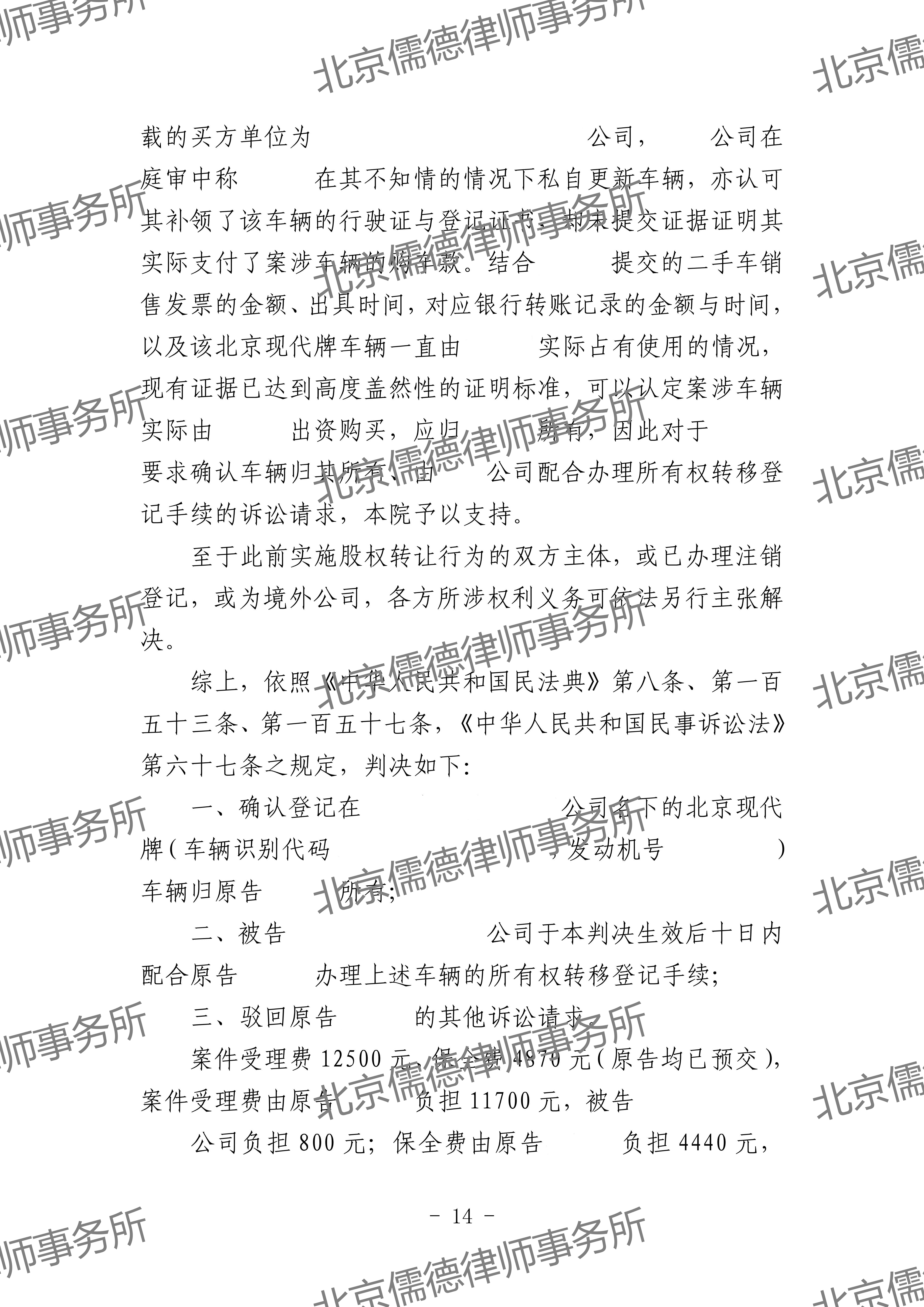
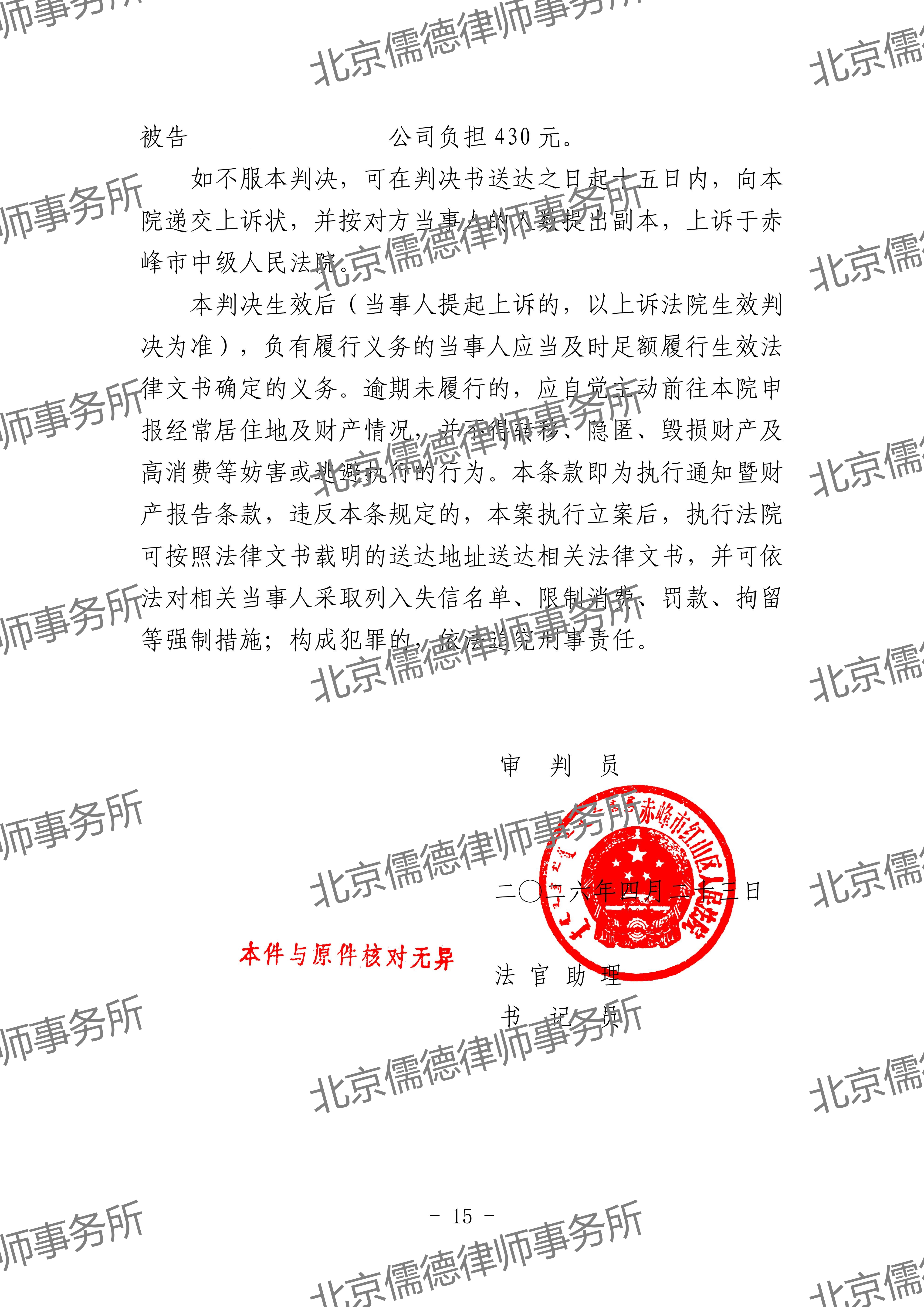
Ultimately, the court adopted most of the defense arguments presented by Attorney Cheng Mingxin from Rudel Law Firm and rendered a just judgment: confirming that th in question belongs to Party A, and ordering Company A to assist in the transfer of ownership; dismissing Party A's claims in their entirety, including the request for Part B to pay 270,000 yuan for equity transfer and 600,000 yuan in compensation; and dismissing Party A's claim for joint liability against Cy A. In this case, the Rudel lawyers successfully helped Party B and Company A avoid a massive liability of 8.7 million yuan and joint liability, leaving them with only the procedural oon to assist in the transfer. The litigation outcome far exceeded expectations.
1. The trading, leasing, or disguised transfer of Beijing passenger vehicle quotas is prohibited. Courts will deem
agreements that circumvent policies through equity transfers or cooperative operat invalid and will not support claims
for liquidated damages or compensation.
2. When signing an equity transfer agreement, the subject matter of the transaction must be clearly defined to avoid
embeddingicle license quota into the equity consideration, thereby preventing the loss of both money and rights.
3. After a company name change or shareholder change, it is essential to clarify historical contractual bilities; do not
readily assume liability for contracts not personally signed.
4. In disputes involving "equity license plate" arrangements, immediately engage a professional lawyer to preserve
evidence and defirelationship, which can significantly reduce the risk of losing the case and minimize economic losses.